










Hindutva racism getting busy customising Bengal
text_fields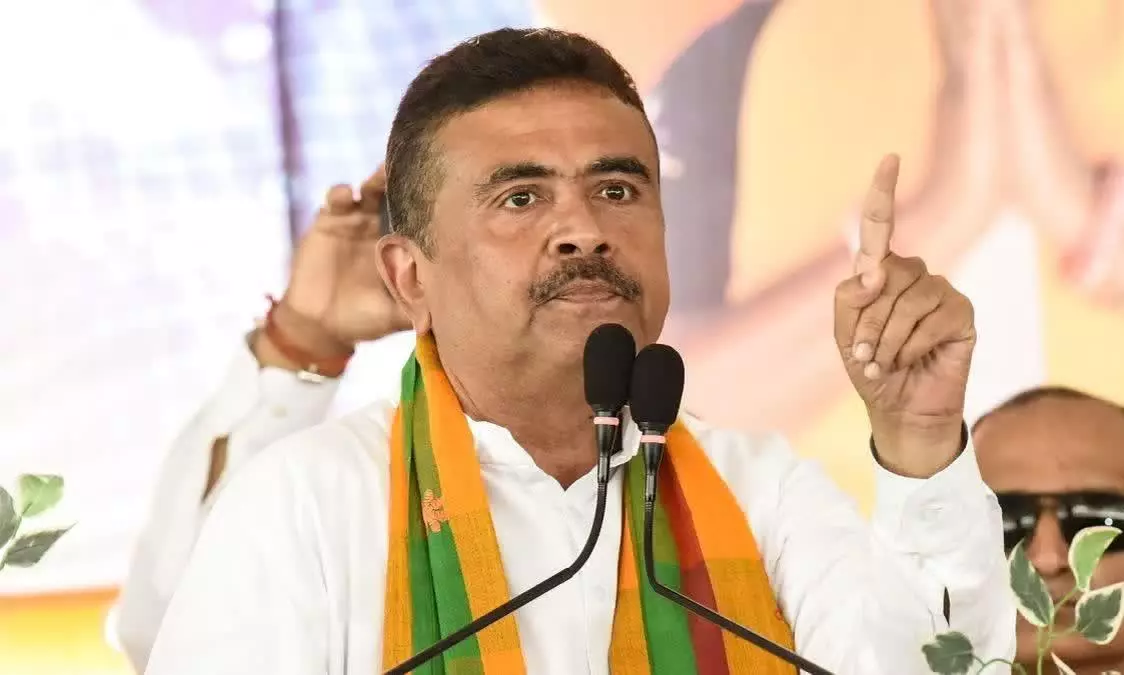
West Bengal's BJP chief minister Suvendu Adhikari
Suvendu Adhikari, who was in the forefront of the Nandigram movement and of the Trinamool Congress, was once a leader who cherished the rights of minorities and farmers in West Bengal. Although the farmers of Nandigram were Muslims, he stepped in to save their lives. But the period after his entry into the BJP proved that Suvendu had an extremely vile and cunning anti-social streak lurking in his mind. Thus today's textbook Suvendu is the depth of how politics pollutes a person. It was after he was caught in the corruption footage released by the Narada News Portal that Suvendu joined the BJP overnight and broke free from the net that the CBI had started to cast for him. When the BJP came to power after decades in the land of Shyama Prasad Mukherjee, the founding leader of the Jana Sangh, Suvendu was the one destined to become its leader. The BJP was using such masked pseudo-secularists to stir up communalism in Assam and Bengal. It was Himanta Biswa Sarma, a former Congress leader, who was commissioned for this role in Assam. Suvendu has been running wild in Bengal since his first day with a deep-rooted communalism that even those who came through the Jana Sangh or the RSS cannot display now.
Suvendu, who played politics on the BJP's lie about Bangladeshi infiltration, naturally had to start by activating the movement to deport 'foreigners'. The West Bengal government announced a scheme for this called 'detect, delete, deport'. But no country with the rule of law would admit as its citizens those who India would try to deport labelling them as foreigners by citing minor errors in their documents. Suvendu had announced that 5,000 Bangladeshi citizens had been deported as soon as he came to power and that 12,000 more would be sent immediately. However, no reports anywhere show that Bangladesh has officially accepted so many people, except that they were sent to detention camps inside India or kicked out under the cover of darkness. Although some tribunals have ruled, based on typos in their documents, that these people are not citizens of India, only a handful of cases have been found so far with proof that they are genuine citizens of Bangladesh and came to India from there. Some reports say that the number of people officially excluded by India in the last three decades is less than 30,000. Meanwhile, it should be remembered that the people who were deleted by India from the National Register of Citizens due to irregularities in their documents would number 1.39 crore in the first list. This is the figure released by the Press Information Bureau.
The Financial Express newspaper has shared some shocking information in a report published on July 1. This report - that India is pushing people through the vulnerable areas of the border under the cover of night and at gunpoint - is something that should never be heard from a republic that believes in the rule of law. The report also says that the Bangladeshi army is asking the Indian army through public address system not to push people across the border in this way. The Financial Express points out, citing senior officials of the Bangladeshi army, that many people illegally pushed by India are stuck in the 'no-man's land' between the borders of the two countries.
Illegal detention camps
India has no obligation to tolerate illegal immigration of citizens of Bangladesh or any other country. Whether it is Sheikh Hasina or Taslima Nasreen or ordinary people without such VIP status, every citizen would want India not to become a haven for such people. And the central government should come up with concrete plans to ensure that not only West Bengal, but even any other Indian state, does not become a haven for refugees in that sense. But the Financial Express report and the cases of Danish, Sweety Biwi, Qurban Sheikh, Iman Sheikh, etc., whom the Supreme Court asked India to bring back from Bangladesh, raise serious doubts about the central government's deportation plan. The story of Sonali Sheikh, who was sent to Bangladesh under the cover of darkness from Bengal, is no different. She was nine months pregnant when she who earned a living by collecting plastic scrap and selling it in Delhi, and their eight-year-old son, were deported along with her husband to Bangladesh, a country they had no connection with. The fate of this family, who had Indian documents in hand, was to end up in a detention camp in that country. Finally, the Calcutta High Court intervened in the matter and directed the Central government to bring them back. The Centre deported them without waiting for the decision of the then Chief Minister Mamata Banerjee. The court's intervention came after Mamata submitted a police report stating that Sonali Sheikh, a resident of Birbhum district of West Bengal, and her family have Indian citizenship, that her father Bodu Sheikh is an Indian citizen, and that there are documents available proving that she has roots in India since her grandfather's time. The tribunal had not properly scrutinised the citizenship documents of Sonali's family until she took the case to the High Court by pledging even her bed.
Equally deserving of review is another report on the same issue that came out on May 29. Union External Affairs Ministry spokesperson Randhir Jaiswal had informed the media that India had written to Bangladesh regarding the citizenship of 2,680 people currently in detention camps and that they will be deported from India as soon as they confirm it. He also clarified that India has not received any reply to its questions regarding their citizenship in the last five years. On one side is the picture of the status of the cases of the deportees being questioned in the courts. On the other side is the picture of Bangladesh struggling to find answers to India's doubts. If it is certain that they are citizens of that country, why can't India stop Bangladesh from beating about the bush and make it answer? This chronology makes it clear that the Ministry of External Affairs has sent a letter seeking an explanation regarding these people right since the time of Sheikh Hasina. This was also the time when India had good diplomatic relations with Bangladesh. It is clear that there are obvious discrepancies in the cases of those who could not be deported, those who had to be brought back after being deported, and those who still have to be deported. Complaints have also been heard in Assam and Bengal for years that officials destroy documents proving citizenship submitted by Muslims. The Registrar General of India had announced an inquiry into such a complaint about some officials in Kamrup district. An article published in Time magazine on August 14, 2018, explained the difficulties faced by even Muslims despite having documents on the issue of citizenship.
Muslim organizations in the state are concerned that the government's directive to identify 'illegal immigrants' in the state within six months will end up being just a continuation of the routine moves by the government in this region so far. The government's deadline for deciding on existing applications is seen as a move to reject as many Muslim applications as possible and send them to detention camps rather than granting new citizenship to anyone. However, Suvendu explains that the aim is not to expel anyone, but only to find people entitled to citizenship. Since all the moves so far in this area have been limited to ethnic targeting of one community, assuming that the current Bengal Chief Minister will stick to the law and follow a different path would be the height of folly.
Denial of ration distribution
Regarding the abolition of the honorarium of Rs 2000 given by the Mamata Banerjee government to madrassa teachers and imams, Suvendu government argued that it was part of ending all kinds of religious appeasement. However, reports have it that the distribution of ration to those whose names were removed from the SIR has also been stopped in Bengal. If the deceit shown to win the election turns into such a decision in the subsequent period, then it must be said that Suvendu is driven by anti-social and criminal communalism. As soon as he took office, the new Chief Minister made it clear that Muslims did not vote for him and that there would be no special consideration for them. And many of the laws implemented in the state after the BJP government came to power are becoming racism in the guise of reform. The 1950 law regarding the slaughter of animals was taken out of the dustbin to prevent the sacrificial rituals during Eid-ul-Adha. Although the Muharram procession is not a rite mandated by religion, the restrictions imposed by Suvendu underline the fact that the restrictions imposed by him were part of an agenda of confrontation with a community. Loudspeakers from mosques and prayers in public places were restricted. All these were moves at the government level. But when the Hindutva groups took the law into their hands and ran berserk, what the government did was stand by and watch with folded hands as is the practice in BJP-ruled states.
Call to boycott call in Bengal too
The call by a group of youths under the banner of Hindu Jagran Manch to boycott Muslim traders at Bidan Market in Siliguri was picked up by the media and it caused a stir across the state. Following the pattern of North Indian states, cow protection gangs are also active in the state to take over the sale of cattle. And this comes amidst reports that an active campaign has been launched in Paschim Medinipur under the leadership of local BJP MLA Kaustuv Bhagchi to not consume halal meat. Life in areas like Nadia and Chowgacha is tense. Villages in this area are in fear of Sangh Parivar goons who patrol with weapons.
In northern areas like Jalpaiguri and Raiganj, VHP and Bajrang Dal groups are also in the news for calling for a boycott against Muslim traders. On June 22, the tension in the area following a Hindu-Muslim wedding in Basantapur even led to the deployment of the army. The incident was alleged to be 'love jihad'. Although Nazia Elahi Khan, the leader of the BJP's Muslim Front, publicly called for a boycott of Muslims from government and private jobs for at least three years, no action was taken against her. This was an extremely serious case where a ruling party leader called a press conference calling for racial discrimination.
Hindu-Muslim struggle!
Bengal currently has the dubious distinction of being the state that turned even the student protest against the NEET exam paper leak into a Hindu-Muslim conflict. The Chief Minister's remark about the violence during the protest was that it was unleashed by Jamaat members! Suvendu has clarified that the connection of Islamic fundamentalists with the protest is being investigated and that as soon as the report is received, strict action will be taken in such a way that will be remembered by three generations of them. This protest was misinterpreted in Kolkata in a way that even Amit Shah could not do in Delhi.
Curtailment of reservation
During the previous Left and Trinamool governments, the OBC reservation was increased several times and eventually reached 17 percent. After Suvendu came to power, it was decided to reduce the quota to the 7 percent that existed before 2010 and remove several groups, including various Muslim communities, from the OBC list. Mamata Banerjee had added 77 new groups to the reservation list through an order issued in 2012. The vast majority of them were Muslims of Bengal. The BJP had challenged in the court the orders issued by Mamata and the previous CPI(M) government regarding reservation between 2010 and 2012. Just as the Mamata government was about to challenge the verdict in this case, the election was held and the BJP came to power. With this, the BJP government has implemented the order to reduce the OBC reservation to only 66 categories that existed before 2010. At the same time, along with notifying the order, it has also issued an order reducing the reservation percentage on its own. These moves may be justified legally. But when Suvendu asked a question in the meantime as to why his government should provide benefits to Muslims who did not vote for the BJP, it reveals that the basic principle of his government is not the Constitution but rather animosity.
(Translated from Malayalam; courtesy prabodhanam.net)